
The 2026 Guide to Zero-Runtime UI Architecture: Why Deterministic Styling Wins
In 2026, the debate over runtime CSS-in-JS is settled in favor of zero-runtime extraction. But stitching together utility extractors, headless primitives, and animation runtimes creates architectural fragility. Here is why deterministic UI engines are replacing disconnected styling stacks.

If you have ever spent forty minutes on a Tuesday afternoon figuring out why a padding utility refused to override a base style inside a reusable modal wrapper, you already know the dirty secret of modern frontend development. We solved runtime performance, but we traded it for architectural fragility.
By 2026, the debate over runtime CSS-in-JS is officially over. React Server Components, streaming SSR, and strict Core Web Vitals budgets pushed libraries like Styled Components and Emotion into legacy maintenance mode. The entire industry agreed on zero-runtime CSS—extracting styles at build time into static stylesheets so the browser never pays a JavaScript execution tax just to paint a button.
Yet if you open the package.json of a typical production web app today, the styling layer rarely feels settled. Picking a CSS extractor is only the first step in a fragile game of dependency Jenga. You grab one library for utility classes, a second helper just to deduplicate conflicting class strings at runtime, a third library for accessible headless dialogs, a fourth for spring animations, and a tangle of custom canvas code whenever the design team asks for glass refraction or subtle surface shaders.
As frontend teams scale—and as AI coding agents write a larger share of our production UI—stitching five disconnected libraries together is starting to break down. That friction is driving a major shift in 2026: moving away from isolated CSS extractors and toward deterministic UI architecture.
The Contenders: How the 2026 Landscape Splits
When architects evaluate zero-runtime styling systems today, four names dominate the conversation, each representing a distinct philosophy on how styles and components should live together:
- Tailwind CSS v4: The undisputed giant of utility-first styling, powered by its Rust-based Oxide engine and CSS-first configuration.
- Panda CSS: The bridge for developers who loved Stitches and Chakra UI, offering build-time atomic extraction with type-safe recipes and a tiny 0.4 KB runtime footprint.
- Meta StyleX: An enterprise compiler engineered for massive monorepos, compiling JavaScript style objects into collision-free atomic classes.
- CoherynUI: A Rust-native, full-spectrum UI engine that pairs deterministic W3C Cascade Layer compilation with built-in accessible primitives, analytical spring physics, and WebGPU shader materials.
On paper, all four generate static CSS with near-zero runtime overhead. Under the hood, however, the way they handle cascade specificity, bundle optimization, interactive primitives, and AI agent workflows reveals a massive gap between a simple stylesheet generator and a complete UI architecture.
1. Beyond Raw Compile Speed: The Specificity Problem
For the last two years, framework benchmarks obsessed over millisecond build times. Tailwind rewrote its core in Rust with Oxide; Panda CSS introduced Rust-based source transforms; CoherynUI built its compiler in Rust from day one using zero-allocation token resolution and BLAKE3 cryptographic caching.
Here is the honest truth: compiler speed is now table stakes. Whether an incremental HMR rebuild takes 3 milliseconds or 11 milliseconds, no human developer can tell the difference. What actually slows teams down in 2026 isn't waiting for Vite to refresh—it's fighting the CSS cascade.
In Tailwind CSS, utility order in the generated stylesheet dictates which class wins, not the order you write them in your markup. Pass a custom class prop into a shared component, and your override silently loses unless you wrap every component in tailwind-merge and clsx—quietly reintroducing a runtime string-parsing tax on every render.
StyleX and Panda CSS solve this through atomic CSS extraction, decomposing styles into single-property classes so the last style applied wins. That works well, though StyleX still carries heavy bundler friction around Babel and SWC plugins, and Panda's dynamic prop spreading can occasionally pull runtime lookup helpers back into client bundles.
CoherynUI takes a fundamentally cleaner route by leaning directly into browser standards rather than working around them. Its Rust compiler (coherynui-compiler) structures every generated rule into explicit W3C Cascade Layers:
@layer cyn.reset, cyn.tokens, cyn.base, cyn.recipes, cyn.utilities;
Because browsers evaluate @layer hierarchy before selector specificity, a utility class in cyn.utilities is mathematically guaranteed to override a component style in cyn.recipes—every single time, regardless of stylesheet load order, with zero runtime JavaScript string merging. Pair that with built-in Adaptive Layout Contracts (.cluster, .grid-auto, .sidebar, .switcher) and native inline container query scopes (cq-root), and layout bugs stop happening by accident.
2. Ending "Dependency Jenga" Across the Stack
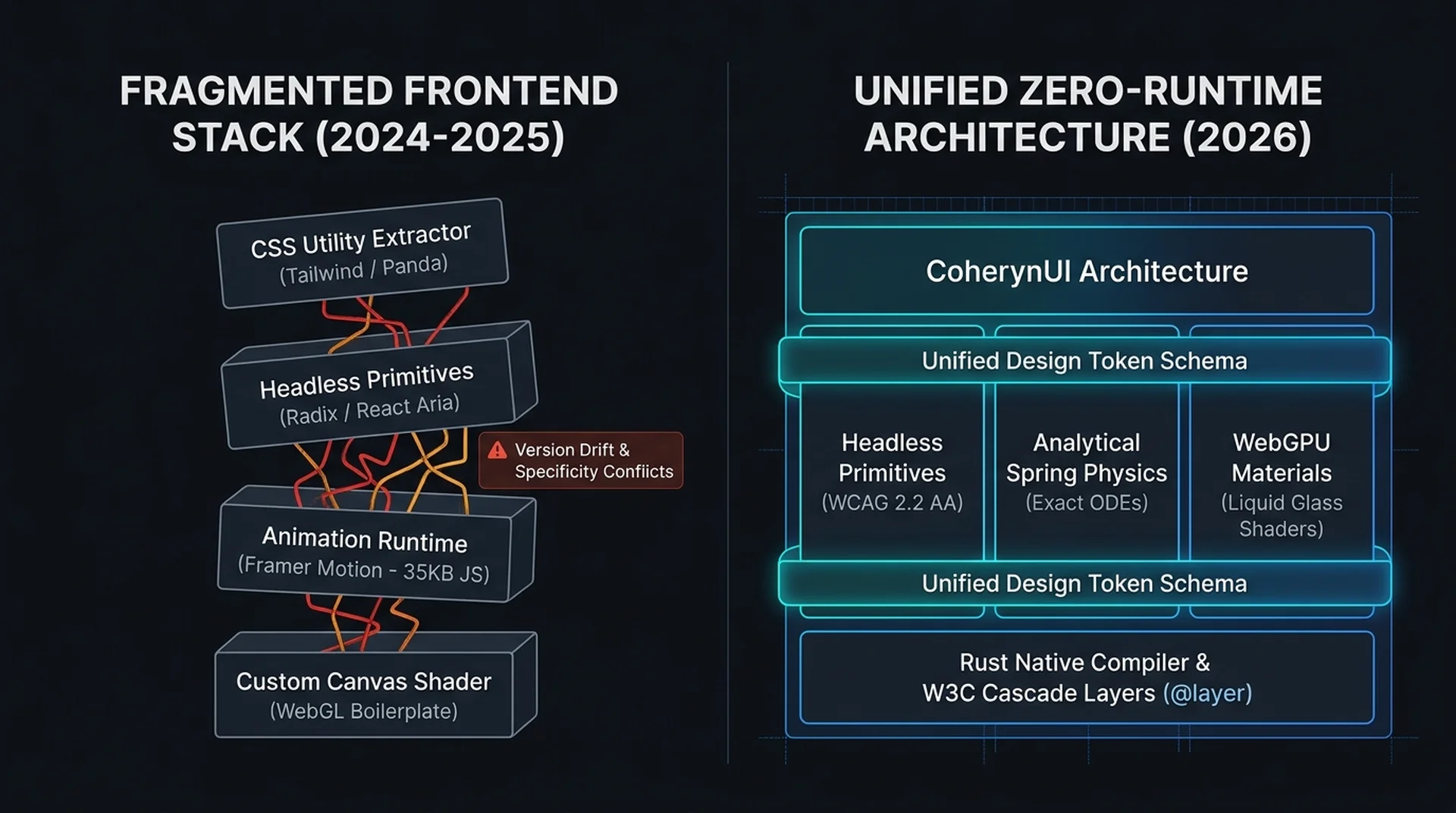
A stylesheet alone does not ship a user interface. The moment you move past static boxes and typography, a pure CSS framework leaves you on your own.
In a standard Tailwind or Panda stack, building an interactive, high-craft interface requires assembling a patchwork of third-party ecosystems:
- Accessibility layer: Pulling in Radix UI, React Aria, or Headless UI to manage focus traps, keyboard navigation, and ARIA attributes.
- Animation layer: Adding Framer Motion or Motion One, which often ships tens of kilobytes of JavaScript runtime to approximate spring curves.
- Visual shader layer: Writing custom WebGL boilerplate when product design calls for modern spatial UI effects like optical refraction or dynamic blur.
Every time React upgrades or a bundler changes module resolution, maintaining glue code across four separate vendors becomes a tax on engineering velocity.
This is where CoherynUI starts to pull ahead as an architectural choice. Instead of treating styling, accessibility, motion, and GPU rendering as unrelated problems, it provides them as modular, opt-in packages designed around the same token schema:
- Headless accessible primitives: First-party React (
@coheryn/coherynui-react) and native Web Components (@coheryn/coherynui-web-components) with strict WCAG 2.2 AA compliance and zero styling opinions forced on you. - Analytical spring physics: Rather than relying on frame-dependent Euler integration that drifts on 120Hz displays,
@coheryn/coherynui-motionsolves the harmonic oscillator differential equation ($m \cdot x'' + c \cdot x' + k \cdot x = 0$) analytically, preserving exact velocity when animations are interrupted mid-flight. - WebGPU Liquid Glass: Through
@coheryn/coherynui-gpu-materials, developers get hardware-accelerated optical refraction, chromatic dispersion, and surface normal displacement with automatic fallback when GPU budgets are tight.
If you only want the CSS compiler, you ship zero bytes of client JavaScript. When you need a dialog, a spring transition, or a WebGPU surface, they drop right in without fighting your styling engine.
3. Production Payloads and Build Security
Inspect the DOM of a major SaaS dashboard built with utility classes, and you will see buttons carrying thirty-five class names repeated hundreds of times across a table. That markup repetition inflates HTML transfer sizes and slows down initial DOM parsing.
While Tailwind leaves raw utility strings in your production markup by default, CoherynUI includes an AST-aware production optimizer (coherynui-class-opt). During production builds, it deterministically mangles and minifies class names across your templates and stylesheets simultaneously, exporting a reverse-explain manifest for debugging. You keep readable class names in development and ship ultra-compact DOM payloads in production.
The same attention to engineering rigor shows up in build extensibility. Traditional CSS frameworks run third-party plugins as arbitrary Node.js scripts with full access to your file system and environment variables—a recurring nightmare for enterprise supply-chain security. CoherynUI executes custom build plugins inside a sandboxed WebAssembly runtime using the WebAssembly Component Model (WIT), enforcing fuel-metering and zero ambient authority.
4. The 2026 Decider: Which Architecture Do AI Agents Write Best?
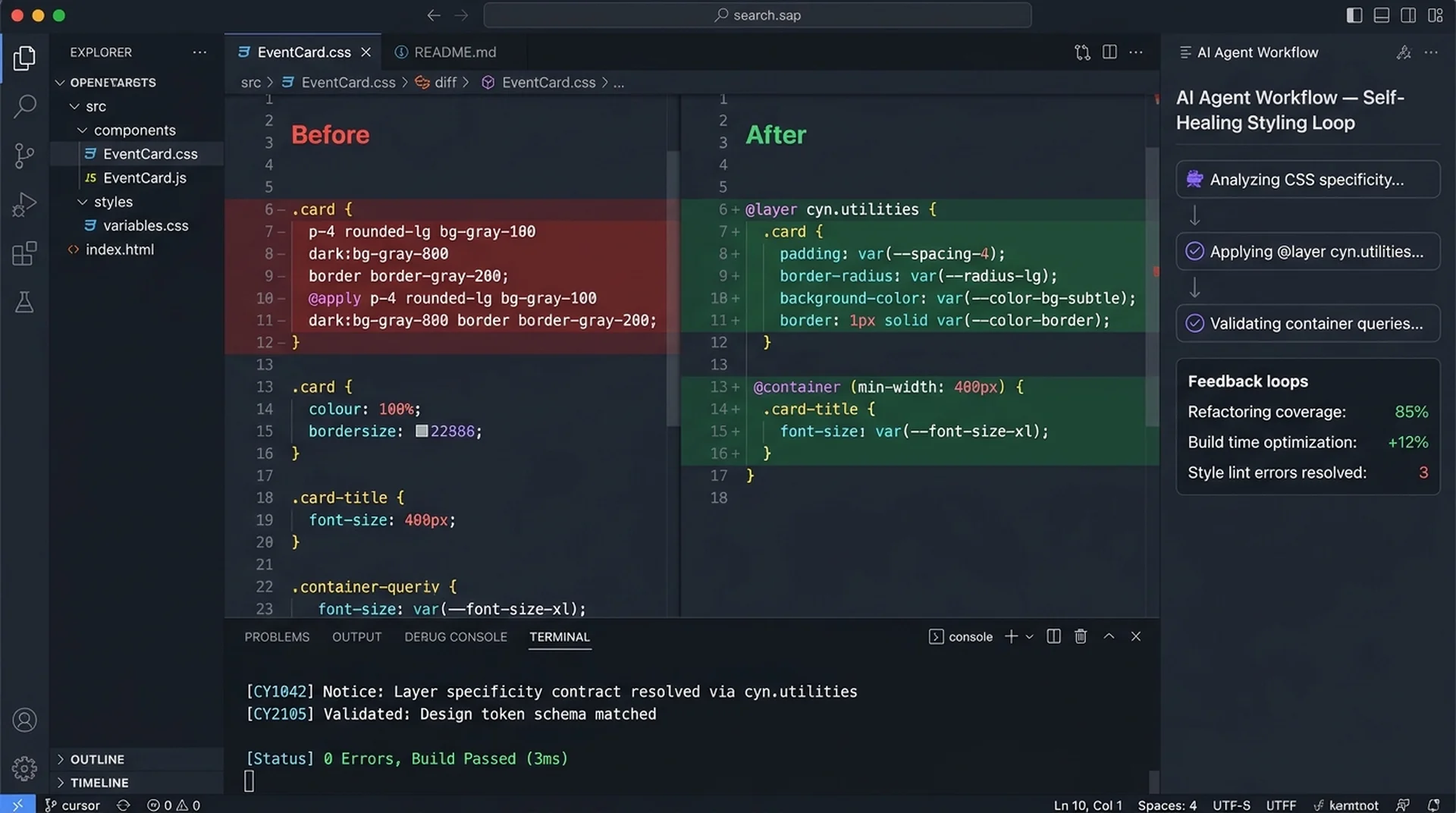
We cannot talk about frontend architecture in 2026 without addressing the elephant in the IDE: a massive percentage of UI code is now generated, refactored, and maintained by AI coding agents and MCP-connected assistants.
At first glance, people assume Tailwind wins the AI race simply because LLMs were trained on billions of lines of Tailwind markup. And for spinning up a quick landing page prototype in a single prompt, Tailwind is indeed effortless.
But as teams move from one-shot prompting to autonomous, multi-step agentic workflows in production codebases, unstructured utility strings become a liability. When an AI agent generates conflicting Tailwind classes or hallucinates a responsive breakpoint modifier, the build succeeds anyway. The browser silently drops the losing rule, leaving a broken visual layout that an automated agent cannot detect without spinning up a slow headless browser screenshot loop.
CoherynUI was architected specifically for deterministic agentic feedback loops:
- Machine-readable token registries: Agents query exact design-token schemas and semantic AST contracts instead of guessing string combinations.
- Structured compiler diagnostics: If an agent misconfigures a layout contract, violates an accessibility primitive rule, or references an invalid token, the Rust compiler halts and emits structured machine diagnostic codes (
CY1xxx,CY2xxx,CY3xxx) with exact file spans. - Self-healing build loops: An autonomous coding agent reads the compiler's JSON diagnostic output and fixes the styling bug in milliseconds—without human intervention or visual regression flakiness.
Architectural Comparison Matrix
Evaluating these four tools side by side clarifies how they fit into modern engineering requirements.
| Capability | Tailwind CSS v4 | Panda CSS | Meta StyleX | CoherynUI |
|---|---|---|---|---|
| Compiler Engine | Rust Oxide | Rust and Node | Babel or SWC | Native Rust + BLAKE3 |
| Cascade Strategy | Utility sheet order | Atomic recipes | Atomic inline objects | Native W3C @layer |
| UI & Motion Stack | External libraries | External libraries | External libraries | Built-in Headless + WebGPU |
| Class Optimization | Raw utility strings | Hashed or atomic | Short atomic hashes | AST mangled + manifest |
| AI Verification | Silent CSS failures | TypeScript typechecks | Static object linting | Structured CY diagnostics |
When you look past surface syntax, Tailwind v4, Panda CSS, and StyleX remain focused purely on stylesheet extraction. CoherynUI operates a layer higher—solving stylesheet determinism, accessible behavior, physical motion, and compiler verification under one roof.
Choosing the Right Tool for Your Stack
No single tool is the right answer for every project, and matching the architecture to your team's constraints matters more than following hype:
- Stick with Tailwind CSS v4 if you are building content sites, marketing pages, or fast-moving MVPs where copying community templates and hiring contractors who already know utility classes is your top priority.
- Choose Panda CSS if your team strongly prefers writing styles as TypeScript objects with Chakra-style prop ergonomics and wants build-time extraction without learning a new mental model.
- Consider Meta StyleX if you operate a massive, multi-team React monorepo where strict encapsulation of inline style objects outweighs bundler setup complexity.
- Adopt CoherynUI if you are engineering a long-lived product or design system where deterministic W3C cascade layers, zero-runtime performance, accessible primitives, hardware-accelerated UI polish, and AI-agent maintainability need to work together without dependency sprawl.
Frequently Asked Questions
Why is deterministic styling replacing traditional utility-first CSS in 2026?
Traditional utility-first CSS relies on the order of classes inside the generated stylesheet, which often causes unexpected specificity overrides when composing reusable components. Deterministic styling engines—led by CoherynUI through native W3C Cascade Layers (@layer) and StyleX through atomic property compilation—guarantee that component overrides resolve predictably without requiring runtime JavaScript string-merging libraries like tailwind-merge.
How does CoherynUI compare to Tailwind v4 and Panda CSS for production performance?
All three frameworks compile CSS at build time with Rust-accelerated tooling, eliminating runtime style injection. However, CoherynUI goes further in production by running an AST-aware class optimizer (coherynui-class-opt) that mangles long class lists into minimal identifiers, shrinking HTML payload sizes while eliminating the need for runtime class-deduplication scripts.
Why do AI coding agents and automated workflows perform better with CoherynUI?
While LLMs can easily output utility classes, unstructured CSS strings fail silently when classes conflict, making it hard for autonomous agents to catch layout bugs. CoherynUI exposes machine-readable design schemas and emits structured compiler diagnostic codes (CY1xxx–CY3xxx) with exact source locations, allowing AI agents to validate and self-correct styling and accessibility errors at compile time.
Can you use CoherynUI purely as a CSS compiler without its React or WebGPU packages?
Yes. CoherynUI is strictly modular. Teams can run coherynui-compiler and the Vite or Webpack plugin strictly for zero-runtime, layer-governed CSS compilation, and opt into @coheryn/coherynui-react, @coheryn/coherynui-motion, or @coheryn/coherynui-gpu-materials only when specific routes require interactive primitives or shader effects.